Start with our guide to payment options, then see the pathway for problems with existing dentures if you are still working out what to ask about.
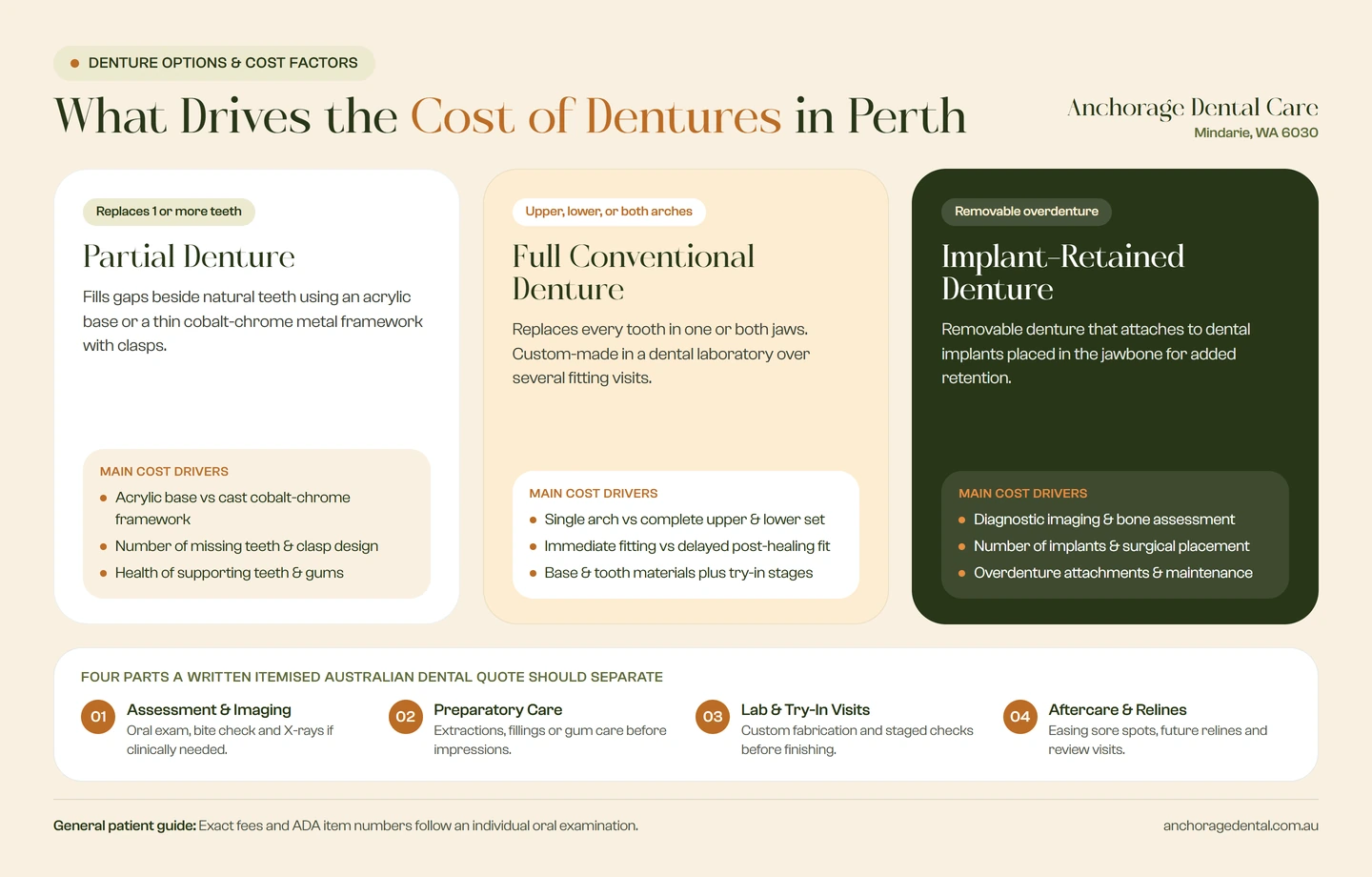
There is no single flat price for dentures in Perth, because the total fee depends on the denture type, the materials used, whether teeth or gums need preparation first, the dental laboratory stages involved and what ongoing adjustments or relines you need after fitting. At Anchorage Dental Care in Mindarie, our dentures service page explains that we examine your mouth and any existing denture first, then provide the stages and written cost of any next step before you agree to treatment. [1]
When patients across Perth compare denture quotes, the wide gap between figures they see online is often confusing. One figure may refer to a single-arch acrylic appliance with no preparatory care, while another reflects a metal-framework partial, tooth extractions or implant attachments. Understanding what sits inside a quote—and how private health fund rebates, DVA entitlements and Western Australian public dental pathways work—helps you compare options on an equal footing.
Summary of key points
- The Australian Dental Association (ADA) describes three main denture types: full dentures, partial dentures (plastic or cobalt-chrome metal framework with plastic) and removable implant-retained dentures. [2]
- Denture fees vary with arch count, base and tooth materials, laboratory stages, preparatory dental work (such as fillings, gum care or extractions) and post-fitting adjustments. [1] [3]
- A clear Australian written quote separates assessment and X-rays, preparatory care, laboratory fabrication and try-in visits, and expected follow-up care using ADA item numbers so you can check rebates with your fund first. [4]
- General Medicare does not usually cover adult dentures, though eligible WA concession card holders can check Dental Health Services WA and eligible veterans can check DVA cover. [4] [5]
- Bringing an existing loose or rubbing denture to an examination lets your dentist check whether easing, repair or relining is possible before discussing a new appliance. [1]
How different denture types affect what you pay
The single biggest driver of denture cost is the type of appliance your mouth needs. Both the ADA and healthdirect group removable dentures into three main categories, alongside fixed tooth-replacement alternatives such as bridges and implants. [2] [3] Each category uses different materials, clinical visits and laboratory work.
| Denture option | Teeth replaced | Typical materials | Main factors shaping the quote | Ongoing upkeep to budget for |
|---|---|---|---|---|
| Acrylic partial denture | One or more missing teeth alongside natural teeth | Plastic (acrylic) base with prosthetic teeth and clasps | Number of missing teeth, bite design, health of remaining teeth and laboratory finishing | Daily cleaning, easing sore spots, occasional clasp checks, relines or tooth additions if assessed as suitable |
| Metal-framework partial denture | One or more missing teeth alongside healthy natural teeth | Thin cast metal framework (commonly cobalt chrome) with acrylic gums and teeth | Custom cast metal laboratory work, tooth preparation for rests/clasps and number of teeth replaced | Daily cleaning around clasps and natural teeth, routine dental check-ups and periodic fit reviews |
| Full conventional denture | All teeth in the upper jaw, lower jaw or both arches | Custom-moulded acrylic base and matched prosthetic teeth | Single arch versus both arches, base and tooth selection, multiple lab try-in stages | Regular oral tissue checks, easing adjustments, relines as gums and bone change shape, eventual replacement |
| Immediate denture | Inserted on the same day teeth are extracted | Custom acrylic appliance prepared from impressions taken before extraction | Extraction fees plus appliance fabrication, followed by more frequent early adjustments as gums heal | Early easing visits, temporary liners or relining once extraction sites settle |
| Implant-retained denture | Multiple missing teeth or a full arch, removable for cleaning | Removable overdenture clipped onto implants placed in the jawbone | 3D imaging, bone assessment, number of implants, surgical placement, healing time and attachment components | Daily cleaning of both denture and implant attachments, replacement of worn clips/inserts and routine implant reviews |
Partial dentures: acrylic versus cobalt-chrome metal frameworks
If you still have healthy natural teeth, a partial denture replaces only the missing gaps and grips or rests against nearby teeth. Better Health Channel notes that partial dentures can be made from plastic, metal or a combination of both, and that your remaining teeth and gums must be in good health to support the appliance. [6]
An acrylic partial uses a plastic base and is often discussed when a simpler or transitional design is needed. A metal-framework partial uses a thin cast alloy—mainly cobalt chrome—combined with acrylic teeth and gum-coloured acrylic. [2] [3] Because casting a precision metal framework involves extra dental laboratory steps and careful planning around supporting teeth, the quoted fee differs from an all-acrylic partial. At Anchorage Dental Care, dentures are made in a dental lab in acrylic, and partial dentures can be made with a metal framework depending on what your assessment shows. [1]
Full conventional dentures: single arch versus upper and lower sets
A full denture replaces every tooth in the upper jaw, the lower jaw, or both. The ADA explains that full dentures are usually made from acrylic plastic, sit directly on the gums, and help support the lips and cheeks while maintaining the distance between the nose, mouth and chin. [2] Replacing both upper and lower arches involves more laboratory fabrication and bite registration steps than replacing a single arch alone, which is why single-arch and full-set estimates should never be compared as like-for-like.
Immediate dentures versus waiting for gums to heal
When remaining teeth need to be removed, timing directly affects both your initial quote and your follow-up costs. Healthdirect explains that an immediate denture is prepared while your old teeth are still present and inserted on the day of extraction, whereas waiting a few months allows the gums to heal so you typically need fewer adjustments once the denture is fitted. [3] Because gum tissue and bone reshape noticeably after extractions, anyone choosing an immediate denture should ask upfront how follow-up easing visits and later relines are billed.
Implant-retained dentures and fixed alternatives
If you are comparing conventional dentures with an implant-retained overdenture—where a removable denture clips onto implants placed in the jawbone—or with fixed dental implants or bridges, the clinical pathway is very different. [2] Implant planning requires diagnostic imaging, bone and gum assessment, surgical implant placement, healing time while the implant fuses with the jawbone (commonly around 3 to 6 months, depending on individual healing), and specialised attachment components. [1] Suitability, surgical risks, healing limits and ongoing maintenance all need individual discussion with your dentist before comparing long-term costs.
Clinical and laboratory factors behind a Perth denture quote
Even for the same denture category, two patients in Perth can receive different written estimates. That difference reflects real clinical work rather than arbitrary pricing:
- Preparatory dental treatment: Decay, loose teeth, fractured fillings or active gum inflammation often need attention before final impressions are taken so the denture rests on stable tissue and healthy supporting teeth. [1] [6]
- Diagnostic records and X-rays: Your dentist checks your remaining teeth, gums, bite and soft tissues, and discusses X-rays when the examination alone does not show enough beneath the gums or around roots.
- Custom dental laboratory stages: Dentures made in a dental laboratory take several appointments over a few weeks so impressions, bite measurements and wax try-ins can be checked in your mouth before the final acrylic or metal appliance is finished. [1]
- Repair, easing or relining instead of a new denture: If you already wear a denture that rocks, clicks or rubs a tender spot, you may not need to pay for a full remake. Checking the denture in your mouth sometimes shows that easing a pressure spot, repairing a crack or relining the fitting surface is a more practical step. [1]
- Clinician pathway: In Australia, dentures can be provided by a dentist, a dental prosthetist or a specialist prosthodontist depending on clinical complexity and whether natural teeth, extractions or implants are also involved. [6]
What an itemised Australian dental quote should cover
One practical detail many online price guides leave out is how to read a written Australian dental quote. Before you agree to any denture plan, ask for an itemised treatment estimate listing each stage and its Australian Dental Association (ADA) item numbers. [4] Separating the quote into four parts makes it clear what is included and what might sit outside the base fee:
- Initial assessment and imaging: The first examination has its own fee, separate from any adjustment, repair or new denture. Confirm whether X-rays or study models are itemised separately. [1]
- Preparatory care: Any tooth extractions, fillings, scale and clean visits or gum treatment required before final impressions should appear as separate line items with their own item numbers and timing.
- Denture fabrication and try-in visits: Prosthodontic denture item numbers (typically in the ADA 700-series for full dentures, partial dentures, tooth additions, relines and repairs) cover the specific appliance being made and its clinical fitting stages. Ask how many try-in visits are planned before final finishing.
- Post-fitting easing and future maintenance: Small adjustments are a normal part of settling into a new denture. Ask which initial easing reviews are included with delivery of the new denture, and what later repairs, relines or annual review visits are billed separately. [1]
If you are comparing estimates from two Perth practices, checking whether both quotes include preparatory care, try-in visits and early post-fitting easing prevents surprise out-of-pocket bills halfway through treatment.
From first assessment to fitted denture: step by step
Knowing the order of appointments helps you plan both your diary and your budget, especially when treatment is staged over several weeks.
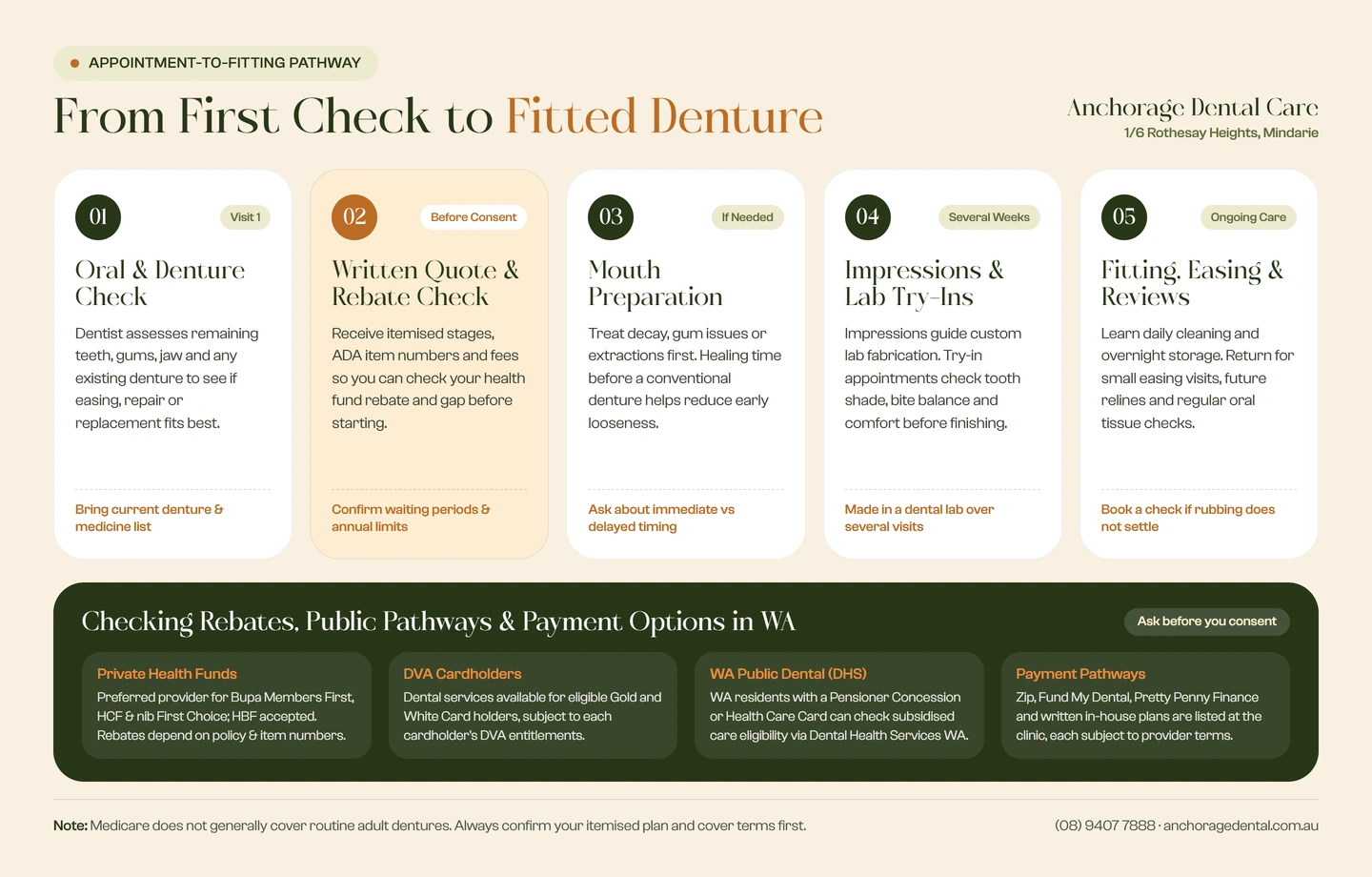
- Step 1 — Oral and denture assessment: Bring your current denture in its case (even if it looks intact), a list of your current medicines and any recent dental records. Your dentist examines your remaining teeth, gums, bite, oral tissues and existing denture, and asks what has changed with eating, speaking or comfort. [1]
- Step 2 — Written estimate and rebate check: Your dentist talks through your options—whether that is easing, repair, a new acrylic or metal-framework denture, or fixed alternatives—and gives you the written stages, ADA item numbers and fees before you consent. You can take those item numbers to your private health fund to confirm your expected rebate and out-of-pocket gap. [1]
- Step 3 — Mouth preparation (when required): If decay, gum disease or tooth extractions need managing first, those steps happen before final impressions. If teeth are extracted, your dentist explains the difference between immediate placement and waiting for gum healing. [3]
- Step 4 — Impressions, bite records and lab try-ins: Impressions are sent to the dental laboratory. Over several visits across a few weeks, try-in appointments let you and your dentist check tooth position, shade, speech and bite balance before the denture is processed in its final material. [1]
- Step 5 — Fitting, daily care guidance and easing reviews: When your denture is fitted, the team shows you how to insert, remove and clean it safely, and explains which changes should prompt an adjustment visit. Follow-up reviews depend on how your mouth settles. [1]
Private health fund rebates, Medicare, DVA and WA public dental pathways
How much you pay out of pocket in Perth depends heavily on which private cover, government entitlement or payment pathway applies to you.
Private health insurance extras cover
Healthdirect notes that private health insurance extras policies may pay part of the cost of dentures, depending on your level of cover, waiting periods (major dental and prosthodontics often carry longer waiting periods than general check-ups), annual limits and remaining benefit balance. [4] Because dentures can span several weeks, check with your fund how item numbers and staged visits interact with your policy's annual reset date.
Anchorage Dental Care accepts private health fund claims and is a preferred provider for Bupa Members First, HCF and nib First Choice, and accepts HBF. [1] Before any treatment starts, our reception team helps check whether your claim can be processed on the day and explains your likely gap once the dentist has confirmed the exact item numbers. Your final rebate always depends on your individual policy and fund rules.
Does Medicare cover dentures for adults?
Healthdirect states clearly that Medicare does not generally cover routine adult dental care, including dentures. [4] While the Child Dental Benefits Schedule (CDBS) helps eligible children aged 0 to 17 with covered basic dental services, adult patients in Perth rely on private health fund extras, eligible veteran entitlements, Western Australian public dental services or self-funded payment options.
Western Australian public dental care and concession pathways
Many top-ranking commercial price pages overlook public pathways available in WA. Through Dental Health Services (DHS), part of the WA Department of Health, Western Australian residents who hold a current Commonwealth Pensioner Concession Card or Health Care Card may be eligible for subsidised adult public dental care—including denture assessment and treatment—subject to eligibility rules, clinical prioritisation and waiting lists. [5]
When public clinic capacity is limited, Dental Health Services WA also administers private subsidy schemes such as the Metropolitan Patients' Dental Subsidy Scheme (MPDSS) and Country Patients' Dental Subsidy Scheme (CPDSS), where eligible patients issued with a General Treatment Authority voucher can attend participating private dental clinics under public subsidy fee arrangements. [5] Note that a WA Seniors Card on its own does not automatically qualify for public dental care without an eligible Centrelink concession card. To check current WA eligibility, waiting lists or clinic locations, contact Dental Health Services WA directly via dental.wa.gov.au or on (08) 9313 0555.
Department of Veterans' Affairs (DVA) cardholders
Anchorage Dental Care provides dental services for eligible DVA Gold and White Card holders. [7] Exact coverage and any prior-approval requirements for dentures depend on each cardholder's DVA entitlements, so bring your DVA card to your initial assessment so the team can verify what applies before treatment begins.
Spreading treatment costs with payment options
For patients funding denture care privately or covering a health fund gap, Anchorage Dental Care lists Zip (Zip Pay and Zip Money), Fund My Dental, Pretty Penny Finance and written in-house payment plans for staged courses of care. [1] [7] Each finance or payment provider sets its own eligibility criteria, approval process, fees, interest and repayment terms, so review your written treatment estimate alongside the provider's terms before applying.
Ongoing costs after fitting: care, adjustments and check-ups
Budgeting realistically for dentures means looking beyond the day the appliance is fitted. Gums and jawbones naturally change shape over time, and prosthetic teeth and acrylic bases experience everyday chewing wear. [1] Over the years, most denture wearers need periodic easing visits, relining to restore snugness, occasional repairs or eventual replacement—though exact service life varies widely between individuals.
Looking after your denture and mouth each day helps protect both the appliance and your gums from avoidable irritation and damage:
- Clean dentures outside your mouth daily: The ADA recommends taking dentures out to clean them using a denture brush or a spare soft toothbrush with a liquid cleanser rather than regular toothpaste, which can scratch acrylic surfaces. [1] [2]
- Brush your mouth separately: Clean your gums, tongue and any remaining natural teeth with a soft toothbrush each day to keep oral tissues healthy. [1]
- Remove dentures overnight: Both the ADA and Better Health Channel advise taking dentures out at night, cleaning them and storing them safely so your gums can rest, unless your dentist gives specific instructions otherwise. [2] [6]
- Avoid home adjustments: Never file, bend or glue a rubbing or cracked denture yourself; bring it to your dentist so it can be assessed safely. [1]
- Keep regular dental check-ups: Healthdirect advises seeing your dentist or dental prosthetist at least once a year even with full dentures so they can check fit, oral tissues and gum health. [3]
Questions to bring to your denture consultation in Mindarie
Whether you are getting your first partial denture or checking an older full denture, bringing a short checklist helps you leave with clear numbers and realistic expectations:
- Does my current denture need a replacement, or would easing, repair or relining address the problem?
- Which denture design (acrylic partial, metal-framework partial, full denture or implant-retained option) suits my remaining teeth, gums and bite—and what are the limitations of each?
- What preparatory dental work, if any, is needed before impressions are taken?
- Can I have a written itemised estimate with ADA item numbers for each stage so I can check my health fund rebate?
- How many visits over how many weeks are planned, and which follow-up easing adjustments are included?
- If I experience dry mouth from medicines, how might that affect denture comfort and retention?
Anchorage Dental Care is a QIP-accredited general dental clinic at 1/6 Rothesay Heights, Mindarie, WA 6030, led by Principal Dentist Dr Michael Shams since 2011 and welcoming patients from Mindarie, Clarkson, Burns Beach, Kinross, Merriwa and Quinns Rocks. We are open Monday to Thursday 8:00 am–6:00 pm, Friday 8:00 am–5:00 pm and Saturday 8:00 am–1:00 pm. To arrange a denture assessment or check an existing denture, call (08) 9407 7888, visit our contact page or book an appointment online.
Frequently asked questions
Why can dental clinics in Perth not give one flat price for dentures before an examination?
There is no single flat price for a denture because the clinical plan depends on how many teeth are missing, the health of your remaining teeth and gums, whether any extractions or preparatory treatment are needed, and which denture design suits your mouth. After an oral examination, your dentist can give you a written itemised estimate with ADA item numbers and stage fees before you agree to treatment.
What changes the cost between an acrylic partial denture and a metal-framework partial denture?
An acrylic partial denture uses a plastic base, while a metal-framework partial uses a thin cast metal framework—commonly cobalt chrome—combined with acrylic teeth and clasps. Laboratory fabrication, materials, clasp design and how the denture rests against your remaining natural teeth differ between the two designs, so your dentist compares both options and their itemised fees after checking your mouth.
How long do you have to wait to get dentures after teeth are extracted?
Timing depends on whether you and your dentist plan an immediate denture or wait for your gums to heal first. According to healthdirect, an immediate denture can be prepared beforehand and inserted on the day teeth are removed, though it commonly needs adjustments as the gums heal; waiting a few months after tooth removal lets the gums settle so fewer early adjustments are needed.
Does Medicare Australia cover dentures for adults in Perth?
According to healthdirect, Medicare does not generally cover routine adult dental care or dentures. Eligible adults who hold a current Commonwealth Pensioner Concession Card or Health Care Card can instead check subsidised public dental care through Dental Health Services WA, while eligible Department of Veterans' Affairs Gold and White Card holders can check dental entitlements under DVA arrangements.
Can WA concession card holders access subsidised dentures?
Western Australian residents who hold a current Commonwealth Pensioner Concession Card or Health Care Card may be eligible for subsidised adult public dental care through Dental Health Services WA, subject to clinical assessment, eligibility rules and waiting lists. In some cases, Dental Health Services WA also issues subsidy vouchers under schemes such as the Metropolitan Patients' Dental Subsidy Scheme for participating private clinics.
What should I check with my private health fund before starting denture treatment?
Take the written itemised estimate and ADA item numbers from your dentist and ask your health fund what rebate applies under your specific extras policy. Confirm whether waiting periods have been served, how much of your annual dental or major dental limit remains, whether stage-by-stage claims affect calendar-year limits, and whether your clinic participates in your fund's preferred-provider network.
Can my existing denture be adjusted or repaired instead of paying for a new one?
Often, yes, if the denture base is still sound and the issue is localised rubbing, mild looseness or a minor repair. Bring your current denture in its case to an assessment so your dentist can examine your gums, remaining teeth and the denture together before advising whether easing, a repair, a reline or a replacement fits what they find.
Sources and clinical note
Sources checked on 25 November 2026. Written by Dr Michael Shams (Dentist), principal dentist, DEN0001580551. This article provides general patient information and does not replace an individual dental examination or personalised treatment quote. Any dental or prosthodontic procedure carries potential risks, limitations and ongoing maintenance requirements; your dentist will assess your mouth and discuss suitable options, alternatives and written fees before you consent to treatment.
- [1] Anchorage Dental Care: Dentures in Mindarie (checked 25 November 2026).
- [2] Australian Dental Association (teeth.org.au): Dentures (checked 25 November 2026).
- [3] healthdirect Australia: Dentures (checked 25 November 2026).
- [4] healthdirect Australia: Cost of dental care (checked 25 November 2026).
- [5] Dental Health Services WA (WA Department of Health): Adult Dental Services (checked 25 November 2026).
- [6] Better Health Channel (Victorian Department of Health): Dentures (checked 25 November 2026).
- [7] Anchorage Dental Care: Payment Options and Health Funds (checked 25 November 2026).
- Anchorage Dental Care: Dr Michael Shams, Principal Dentist (DEN0001580551).